Since the mid-1980s, when American scientist Charles Hull developed the first commercial 3D printer, 3D printing technology has undergone a wave of rapid development, and the term "3D printing" is no longer unfamiliar. In the field of ceramic manufacturing, the application of 3D printing technology is also increasing year by year, and many ceramic designers & studios are consciously combining this cutting-edge technology with daily creation.
An era of ceramics 3D printing
Pottery is a traditional art in China. As early as 8000-2000 BC (Neolithic Age), the Chinese had invented pottery. From the ancient porcelain unearthed by archaeological excavations, the development of ceramics has roughly gone through these stages: the boldness of the Qin and Han Dynasties, the grandeur of the Sui and Tang Dynasties, the elegance of the Song Dynasty, and the delicacy of the Ming and Qing Dynasties. Each stage of development has shone with its own era in its own history.
Ceramics has developed to today, what field is it shining in itself? The answer is 3D printing.
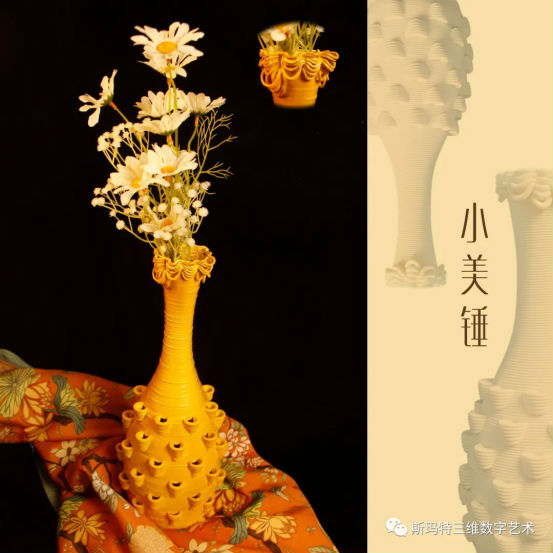
△Ceramic 3D printed works
In traditional pottery making, when encountering more complex or hollowed-out and suspended porcelain, the "standing bone" method is often used to carry out the carving process. The entire process is time-consuming and labor-intensive. If it is not done well in the middle, it needs to be started all over again, which is a great test both physically and mentally.
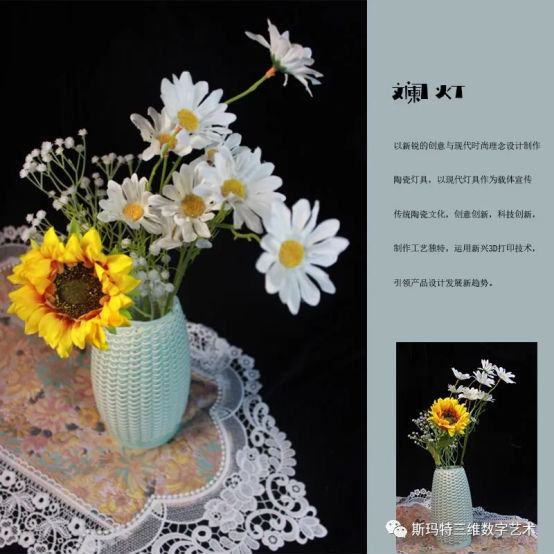
△Ceramic 3D Print Works
And with the help of a ceramic 3D printer, you only need to add support when printing the product, and then directly remove it after the product dries, and then bake and grind it to complete the creation of a work. Since the ceramic 3D is digitized first in the creative process, that is, modeling, it can also achieve mass production like industrial products, without worrying about the problem of having to start all over again if one step is wrong, truly saving time, energy and worry.

△Ceramic 3D printed works
02
—
Future Prospects for 3D Printing Development in Ceramics
It has excellent properties such as high strength, high hardness, high temperature resistance, low density, good chemical stability, and corrosion resistance. With the increasing maturity of 3D printing technology, ceramic 3D printed products can replace existing metal accessories with insufficient heat resistance and wear resistance, such as replacing precision metal accessories with high added value in the aviation engine, photolithography machine, electric vehicle and other industries.
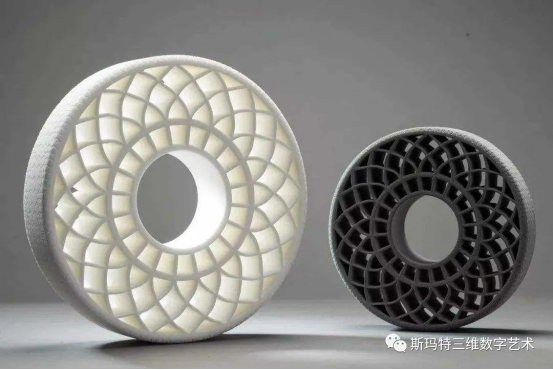
△Advanced ceramics 3D printing
Ceramic 3D printing is an emerging segment in the field of 3D printing that has opened up commercialization in the past 10 years. In recent years, with the participation of major ceramic companies and an increasing number of startups, it indicates that the market is interested in additive manufacturing of ceramics, and therefore, ceramic 3D printing will occupy a place in the broad 3D printing industry, with a predicted market size of $400 million by 2032.